
Slate Summary
Contractors should use an owned website as the central source for accurate services, service areas, proof of work, and inquiry instructions. Social media, directories, and lead platforms can help people discover the business, but a controlled website gives prospects a clearer path and gives the contractor a more durable online asset.
What does it mean for a contractor to own a website?
An owned website is more than another place to list a phone number. It is a digital business asset built around a domain, pages, content, inquiry paths, and core business information that the contractor can control and maintain.
For a contractor, that central destination can explain:
- The services the business provides
- The communities or service areas it covers
- How the work process generally operates
- Relevant qualifications or licenses, when applicable
- Previous project experience and permitted photos
- The best way for a prospect to ask a question or request the next step
This is the main distinction in the contractor website vs social media discussion. A social profile belongs within a platform’s system. An owned website for contractors gives the business a place to organize information according to customer needs rather than according to a third-party profile layout.
Ownership should include practical access, not just the ability to view the site. Check who controls the domain registration, hosting or website account, content, forms, analytics, and business email connections. The contractor or an authorized business representative should be able to update service information and inquiry paths without depending entirely on a platform that may change its rules or access process.
Why is a contractor website more dependable than relying only on social media?
Social media can be useful for showing activity. A contractor might share a completed project, explain a maintenance issue, post a seasonal reminder, or answer a common question. These updates can help the business stay visible where people already spend time.
But social media is not usually organized to answer every question a potential customer has. Important information may be spread across a profile, older posts, photo captions, and direct messages. A prospect may have difficulty determining the full service range, whether the contractor serves a particular location, or what to do next.
A website provides a more dependable destination for complete information. Social posts can point to a focused service page, project page, or contact page instead of requiring a prospect to search through a feed. This creates a clearer path from initial interest to an inquiry.
The local business website vs social media decision does not have to be either-or. Social media supports distribution and engagement; the website serves as the controlled source for important business information. Platform layouts, visibility, and account access can change, so contractors benefit from directing interested people to a destination they control.
For a practical check, open the business’s main social profile as if you were a new prospect. Can you quickly find every core service, the service area, a useful proof example, and a clear next step? If not, the profile should point visitors to a website that answers those questions.
For more guidance on coordinating both channels, see Align Your Website and Social Media.
What information should a contractor’s website make easy to find?
A contractor website should reduce basic uncertainty before someone contacts the business. Visitors should not have to guess what the contractor does, where the business works, or how to begin a conversation.
At a minimum, the site should make these details easy to identify:
- The primary services offered
- The locations or communities served
- The types of projects or customer needs addressed
- The general process or expected next step
- A phone number, inquiry form, or other suitable contact option
- Any relevant qualifications or licensing information the business is permitted to publish
Core services should have understandable explanations. A long list of services may be difficult to use if it gives no context. Separate service pages can explain what the work involves, which project needs may be appropriate, what information the contractor needs from a prospect, and how the inquiry process begins.
Service content should remain accurate and appropriately limited. Contractors do not need to promise a specific result or present every project as suitable for every customer. Clear descriptions help visitors decide whether the business may be a fit without creating expectations the contractor cannot support.
The inquiry path also matters. Phone links should work on mobile devices, forms should request only useful information, and contact options should be visible without excessive scrolling. A visitor who understands the service but cannot find the next step may leave before making contact.
Choose one important service and test the page on a phone. Within a short visit, can a first-time visitor identify the service, confirm the location served, understand the likely next step, and find the best contact method? If any answer is unclear, that page needs attention.
How does an owned website help contractors build trust?
A website gives contractors room to provide context around their work. Project photos, service explanations, process details, qualifications when applicable, and other truthful proof can be organized in a way that helps prospects evaluate fit.
A single image in a social feed may show that work occurred, but it often provides little explanation. A project or proof page can clarify what work was performed, which service it represents, and what a visitor should understand from the example. Contractors should publish only information and images they are permitted to use, and they should avoid adding details that cannot be verified.
Trust is also supported by straightforward communication. A website can explain what happens after an inquiry, what information may be useful during the first conversation, or which types of projects the contractor commonly considers. These details help reduce uncertainty without requiring exaggerated claims or vague statements about being the best.
Proof should be specific and honest. If a project page includes location information, materials, scope, timing, or other details, those details should be accurate and appropriate to publish. When a detail is not available or cannot be confirmed, it is better to leave it out than to fill the gap with an assumption.
Review one project or proof page and ask:
- Does it explain what work was performed?
- Does it give the visitor useful context?
- Is the content accurate and permission-based where needed?
- Does it connect to a relevant service or inquiry path?
Educational content can also support a contractor’s credibility by answering practical customer questions. Building Authority With Educational Content provides a related framework for creating useful information without relying on unsupported claims.
Can contractors use an owned website to support local discovery?
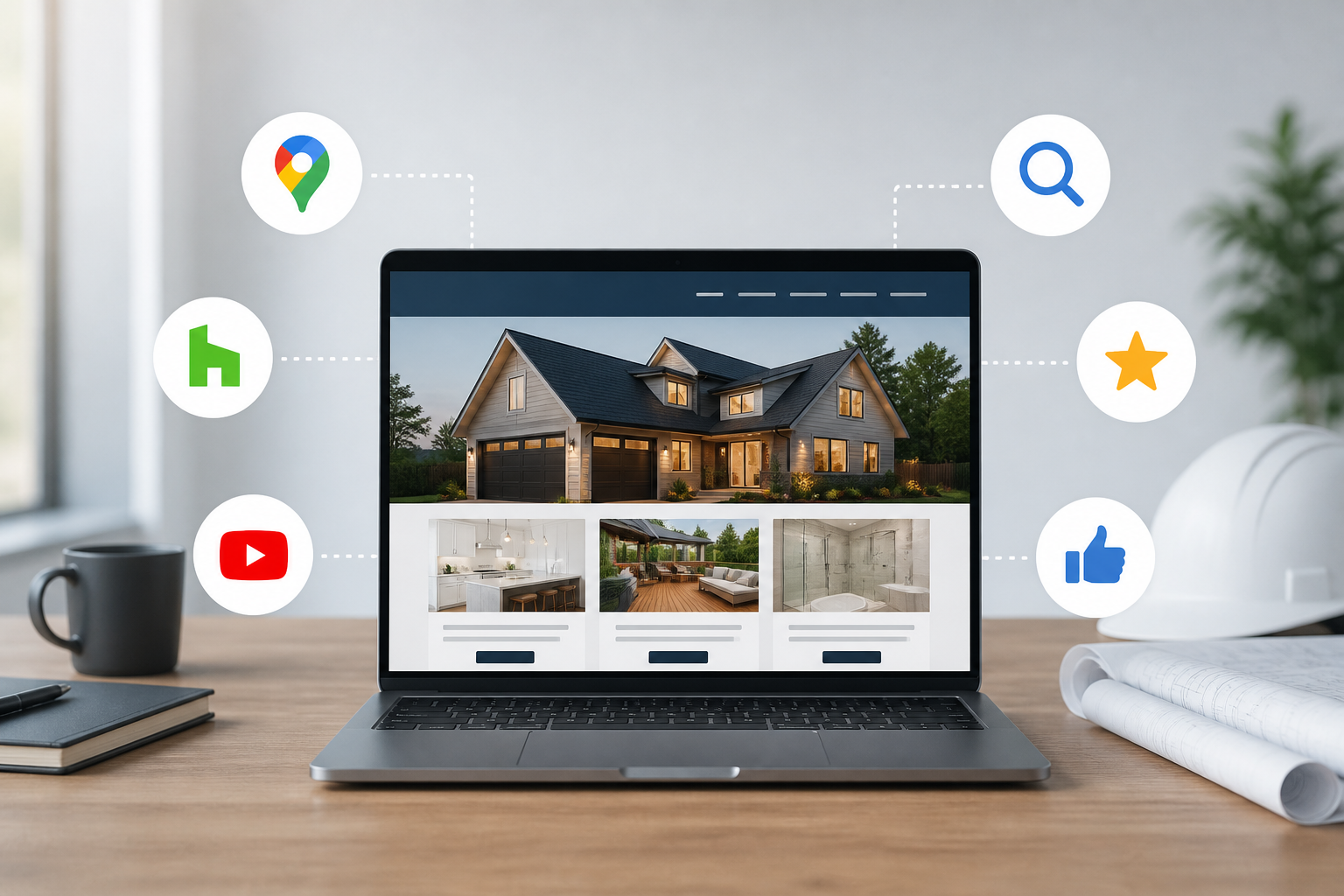
Yes. A website can work alongside local profiles, directories, search visibility efforts, social posts, and lead platforms. Its role is to provide a consistent reference point when someone arrives from one of those channels.
The website should clearly connect the business to its services and service area. A visitor who finds a contractor through a directory or search result should be able to confirm that the business provides the needed work in the relevant location. Organized service and location information makes that decision easier.
Consistency is important. Compare the website with the contractor’s main profiles and directories for matching:
- Business name
- Phone number
- Service descriptions
- Service area
- Website and inquiry-page links
If these details conflict, a prospect may be unsure which information to trust or whether they have reached the correct business. Keep the website and external profiles aligned when services, locations, phone numbers, or inquiry instructions change.
A website supports local discovery, but it should be built first for people. Pages should answer real questions and provide an easy next step rather than exist only to repeat a list of locations or keywords. Contractors can review How to Boost Your SEO Without a Big Agency for additional guidance on practical search visibility work.
What should contractors check before investing in a new website?
Before deciding whether to build or replace a site, evaluate whether the current website supports real customer decisions. A visually polished site can still be difficult to use if it hides services, lacks proof, or makes inquiries inconvenient.
Start with the homepage. It should quickly communicate what the contractor does, which services matter most, where the business works, and what a visitor should do next. A visitor should not need to interpret decorative images or search through menus to understand the business.
Then review the service pages. Important services should have clear explanations rather than being hidden inside a long list, image gallery, or generic paragraph. Look for useful information about project needs, process expectations, and the appropriate inquiry path.
Review proof as well. Are project examples current enough to represent the business? Do the photos and descriptions provide context? Does the contractor have permission to publish the material? Remove or revise anything that is outdated, unclear, or unsupported.
Test the functional experience on a phone:
- Enter through the homepage.
- Find one priority service.
- Confirm the service area.
- Review one proof example.
- Tap the phone link or test the inquiry form.
- Check whether navigation and page content remain usable while moving between pages.
Finally, confirm ownership and access. Identify who controls the domain, site account, content, forms, analytics, and other systems needed to maintain the website. A contractor should understand what can be updated internally and what requires outside assistance.
If a structured review would help, contractors can use the website audit request to examine whether the current site supports clear decisions and inquiries.
How should an owned website work with social media and lead platforms?
The owned website should be the primary source for complete service information, proof, and inquiry instructions. Social media, directories, and lead platforms can then perform more focused roles within the broader marketing system.
Social media can distribute project updates, educational content, announcements, and links to relevant website pages. A post about a particular type of work should lead to the matching service or project page when possible, not simply to a general homepage that makes the visitor start over.
Directories and lead platforms may create additional discovery or inquiry opportunities. Contractors should understand, however, what access and control they retain over those profiles, messages, reviews, leads, and customer information. These platforms can supplement the business’s online presence, but they should not be the only place where essential service information exists.
Consistent messaging makes the system easier to use. The service name, service area, proof language, and next step should make sense across the website and supporting channels. This helps a prospect recognize the business regardless of where the journey begins.
Map one customer journey from a social post or directory listing to a specific website page. Confirm that the destination answers the visitor’s likely question, provides relevant proof or explanation, and makes the next step clear. If the visitor must search again or repeat information unnecessarily, improve the connection between the channels.
An owned website does not replace social media or lead platforms. It gives those channels a stable destination and gives the contractor greater control over the information that shapes a prospect’s decision.
Does your business have one website you control that clearly explains your services and next steps?