
Slate Summary
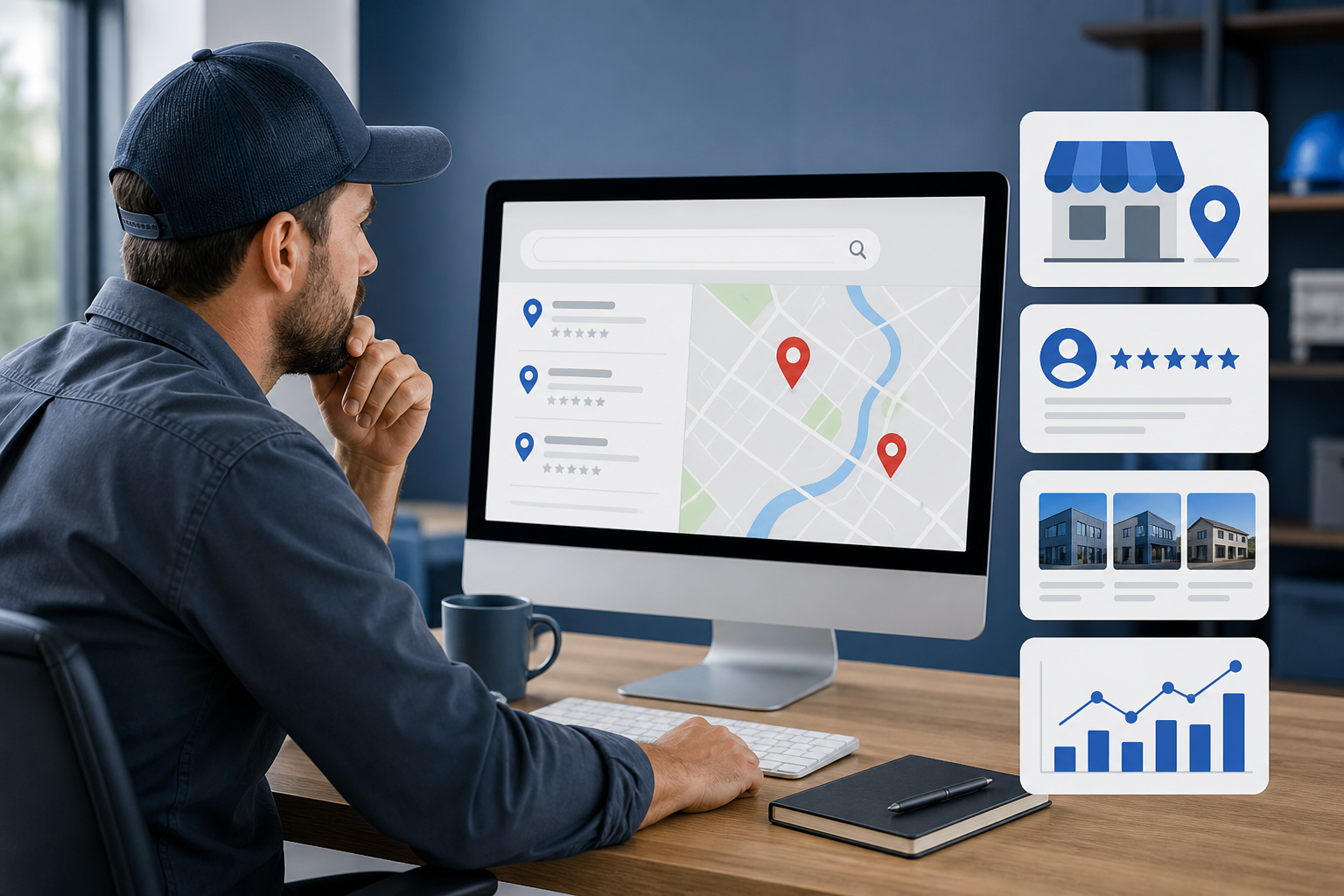
Effective local SEO for contractors connects accurate business details with a useful Google Business Profile, focused service and service-area pages, relevant project proof, and a working contact path. Review these elements from a nearby customer’s perspective, correct the first unclear or outdated item, and maintain the information as the business changes.
What does local SEO for contractors involve?
Local SEO for contractors is the process of making it easier for nearby customers to find, evaluate, and contact your business. It connects your Google Business Profile, website, business listings, service information, project proof, and inquiry process so customers receive a clear and consistent picture of what you do.
For contractors, visibility depends on more than adding a location name to a page. Customers need to understand your primary services, where you work, whether you handle their type of project, and how to reach you. Accurate business information, useful service pages, relevant service-area content, and a straightforward contact experience all support that decision.
Local SEO can improve discoverability and help customers make informed choices, but it does not guarantee rankings or lead volume. Start by checking whether a customer can identify your services, location or service area, and preferred contact method within a short visit to your website. For broader foundational guidance, review how to improve your SEO without a big agency.
Are your contractor business details accurate everywhere?
Inconsistent business information can make it harder for customers to confirm that they have found the right contractor. Review these details carefully:
- Business name
- Address, if customers visit a physical location
- Phone number
- Website URL
- Regular and holiday hours
- Service areas
- Primary services
Use the same accurate information across your website, Google Business Profile, directories, social profiles, and other business listings. Check for old phone numbers, duplicate profiles, closed locations, and service descriptions that no longer reflect the work you take on.
Your operating model should also be clear. A contractor may serve customers from a storefront, travel to job sites, work from a service area without a public office, or use another arrangement. The website and business profiles should communicate that accurately rather than suggesting customers can visit a location that is not open to them.
Create a simple business-information checklist and compare the details on your website, Google Business Profile, Facebook page, major directories, and recent proposal or truck-wrap materials. Correct the most important discrepancies first, especially phone numbers, website links, hours, and service-area information.
How should contractors improve their Google Business Profile?
Your Google Business Profile is often one of the first places a local customer encounters your business. Review it as a customer would, not only as an administrator.
Choose an accurate primary business category and relevant additional categories when they genuinely describe the business. Avoid selecting categories simply because they appear popular or broadly related. Your categories should help customers understand the type of contractor they are considering.
Describe services in language customers recognize. A clear description of the work is more useful than vague wording or a list of broad terms. Confirm your service areas, regular hours, holiday hours, phone number, website link, and any appointment or inquiry options.
Add current photos that help people recognize the business and understand its work. Depending on the business, useful images may include the team, vehicles, work types, equipment, completed projects, or service environment. Use images that represent the current business rather than outdated or generic visuals.
Monitor questions, reviews, and profile updates. Recurring customer questions may show that your profile or website needs clearer information. Reviews should not be treated as a substitute for accurate details, but they can reveal what customers want to understand before contacting a contractor.
Ask whether a homeowner or commercial buyer could determine what you do, where you work, and how to request information without leaving the profile confused. If not, update the most important information before adding more content.
Which service pages should a contractor create or improve?
A focused service page gives customers a place to learn about one important type of work. Create or improve a dedicated page when a service has distinct customer needs, questions, project examples, or scheduling considerations.
A useful service page should explain:
- What the service includes
- Which situations or project types it addresses
- What the process generally involves
- What customers may need to provide or prepare
- Relevant limitations or considerations
- How to request an evaluation, consultation, or estimate
Use specific, customer-friendly language instead of repeating a keyword without adding information. A page about a service should demonstrate that the contractor understands the work and the customer’s decision process.
Connect related services with clear navigation. Someone researching one project may need to compare adjacent services, review project examples, or understand whether the contractor handles a broader scope of work. Helpful internal navigation lets visitors continue researching without starting over.
Review each priority service page for a clear description, evidence that the contractor performs the work, location relevance, realistic project expectations, and one obvious next step. This is a practical part of contractor local search optimization because it connects local visibility with the information customers need before making contact.
How should contractors build useful service-area pages?
A service-area page can help when the contractor genuinely serves the location and can provide useful information specific to that area. It should do more than repeat a standard paragraph while changing the city name.
Explain which services are available in the area, along with relevant project considerations, travel or scheduling context, and the best way to contact the business. If the area has characteristics that affect the work, mention them only when the information is accurate and useful to customers.
Avoid publishing many nearly identical pages for every nearby town. Pages with little original value can make the website harder to manage and give customers no meaningful reason to choose one page over another. A smaller set of useful location pages is often easier to keep accurate.
Link each service-area page to the relevant service pages and contact paths. A visitor should be able to move from a location question to a service explanation and then to an appropriate inquiry option.
For each location page, ask whether a real customer from that area would learn something specific about service availability, project context, or next steps. You can also review how seasonal landing pages can support contractors when planning location and campaign content.
What project proof helps local customers choose a contractor?
Customers often want evidence that a contractor handles work like theirs. Project proof can make the website more useful when it is specific, current, and presented accurately.
Show relevant project types, materials, property contexts, and service areas when appropriate and permitted. Explain the customer’s problem, the work performed, and the outcome without making unsupported claims. Even a concise project description can help a visitor understand the contractor’s capabilities.
Use original photos when available. Add clear captions and descriptive details rather than relying on generic stock images. Useful project information may include the type of work, the conditions addressed, the scope handled, or considerations that affected the process.
Keep project proof organized around the services customers are researching. A visitor looking for a particular service should not have to search through unrelated examples to find relevant work.
Review several project examples and ask whether each one explains what was done, where it was relevant, and why it may help a prospective customer evaluate the business. Remove or update examples that no longer represent the services, locations, or quality of information the business wants customers to see.
Can customers quickly contact the contractor from search and the website?
Local visibility matters only if customers can take a clear next step. Make the preferred contact action easy to find on both mobile and desktop. Depending on the business, that action may be a phone call, inquiry form, email, appointment request, or another established process.
Check that phone numbers, forms, email links, and scheduling instructions are accurate and functional. Explain what information a customer should provide, such as the project type, location, timing, or photos, and clarify what happens after the inquiry.
Avoid unnecessary form fields. Ask only for information that helps determine project fit or prepare for the next conversation. Service-area and project-fit questions should be simple for customers to answer.
Use calls to action that match the actual process. Do not promise a response time, inspection, estimate, or outcome that the business has not established. Clear and accurate wording is more useful than an aggressive promise.
Complete the contact process as a first-time customer on a phone and desktop. Check for broken links, confusing instructions, missing service-area questions, difficult forms, and unclear confirmation messages. If the process is hard for you to complete, it may also be creating friction for prospective customers. A website audit request can help identify issues across the website and inquiry path.
How should contractors maintain local SEO over time?
Local SEO is not a one-time setup task. Business information changes, services evolve, project proof becomes outdated, and customers may continue to ask questions that reveal gaps in the website or profile.
Review your local presence whenever the phone number, hours, service area, location, or service mix changes. Add meaningful project proof as new work is completed, and update service pages when the process, scope, or customer expectations change.
Monitor customer questions and reviews for recurring confusion. If customers repeatedly ask whether you serve a particular area, handle a certain project type, or offer a specific next step, consider whether the answer belongs on the website or Google Business Profile.
Check important pages and inquiry paths periodically on mobile and desktop. Test phone links, forms, email links, scheduling instructions, and confirmation messages. Coordinate website, social, and profile updates so customers do not see conflicting information. This includes aligning the website and social profiles when services, contact details, or service areas change; keeping your website and social media aligned can help structure that review.
Create a monthly or quarterly checklist covering:
- Business details and service areas
- Google Business Profile updates
- Priority service pages
- Service-area pages
- Project proof and photos
- Customer questions and reviews
- Phone links, forms, and other contact paths
A practical local SEO review for contractors
Use this local SEO guide for contractors as a review of the customer journey, not just a list of ranking tasks. A nearby customer should be able to find the business, confirm that it serves the relevant area, understand the work, see evidence of related projects, and contact the contractor without unnecessary confusion.
Start with the first unclear or outdated element you find. Correcting a wrong phone number, improving a thin service page, clarifying a service area, or fixing a broken form can make the local experience more useful than adding another page that customers do not need.
Can a nearby customer quickly confirm what you do, where you work, and how to contact you? Review your Google Business Profile, website service pages, service-area information, project proof, and contact path, then identify the first unclear or outdated element to improve.