
Slate Summary
Effective contractor service page SEO helps visitors confirm the service, location, process, proof, and next step without returning to the homepage. Build each page around those buyer questions, use accurate service-specific information, and make the primary action clear and easy to complete on mobile.
What should a contractor service page help a visitor decide?
A contractor service page should help a visitor decide whether your company addresses the problem they are facing, serves their location, understands the project type, and offers a reasonable next step. It should not require a first-time visitor to return to the homepage for basic answers.
Open with the problem in plain language. Instead of beginning with a broad list of services, explain the situation that may lead someone to research this service. A homeowner may be dealing with a leak, damaged siding, an aging electrical system, or a project they are not sure how to scope. The page should help them recognize that the service is relevant.
The opening sections should also answer four practical questions:
- What problem does this service address?
- Does the contractor provide this specific service?
- Does the contractor serve the visitor’s area?
- What should the visitor do next?
A page that answers these questions supports a decision. A page that only lists services, locations, and generic claims leaves the visitor to assemble the information themselves. For more context on why core website pages should reduce unnecessary navigation, see how long homepages can affect conversion rates.
Quick check: Ask someone unfamiliar with the business to read only the opening sections. Can they explain the problem addressed, the service offered, the service area, and the next step without visiting another page?
How do you match the page to the service a buyer is researching?
Good contractor service page SEO starts with matching the page to the service and the buyer’s likely intent. Use the service name customers recognize, but do more than repeat that name. Explain what the service is for, what conditions may indicate that it is relevant, and what the contractor can discuss or evaluate.
A useful service description should clarify what is generally included and what may require a separate assessment. For example, a roofing repair page can explain that an inspection may help identify whether the issue involves damaged shingles, flashing, ventilation, or another condition. It can also explain that the recommended work depends on the roof’s condition and the scope of the problem.
The same principle applies across home service service page SEO:
- Describe the customer problem before describing the solution.
- Explain which property types or project conditions may be relevant.
- Address common variations of the service without creating a confusing list.
- Clarify when another service, inspection, or conversation may be appropriate.
- Use language that reflects how customers search and speak about the work.
Avoid forcing the primary keyword into every heading or paragraph. Repetition does not replace useful information. A page can be relevant to contractor service pages while using natural variations such as the service name, the customer’s problem, the project type, and the appropriate next step.
Service-fit check: For the page you are reviewing, can a visitor tell what is included, what may need assessment, and what signs suggest the service is worth discussing?
How can the page show that the contractor serves the right area?
Location information should be easy to find on the service page itself. Name the primary service area near the service description or next-step section rather than making visitors search the footer or contact page.
If the contractor serves nearby communities, counties, or neighborhoods, list them only when that information is accurate. A concise statement can explain the broader service area without creating a page for every place name. The goal is to help visitors determine whether contacting the business makes sense.
Avoid thin location variations that change only the city name. A page with no useful local context can create confusion for visitors and add little value. If a location deserves its own page, it should include information that genuinely helps people in that area understand the service, project conditions, or next step.
Make limits clear as well. If service depends on project size, travel distance, property type, or another condition, explain that in straightforward language. Clear boundaries can prevent an unsuitable inquiry and help a qualified visitor move forward with more confidence.
Location check: Review the page as a homeowner who has never visited the website. Can that person identify the service area without opening another page?
What page structure makes contractor service information easier to use?
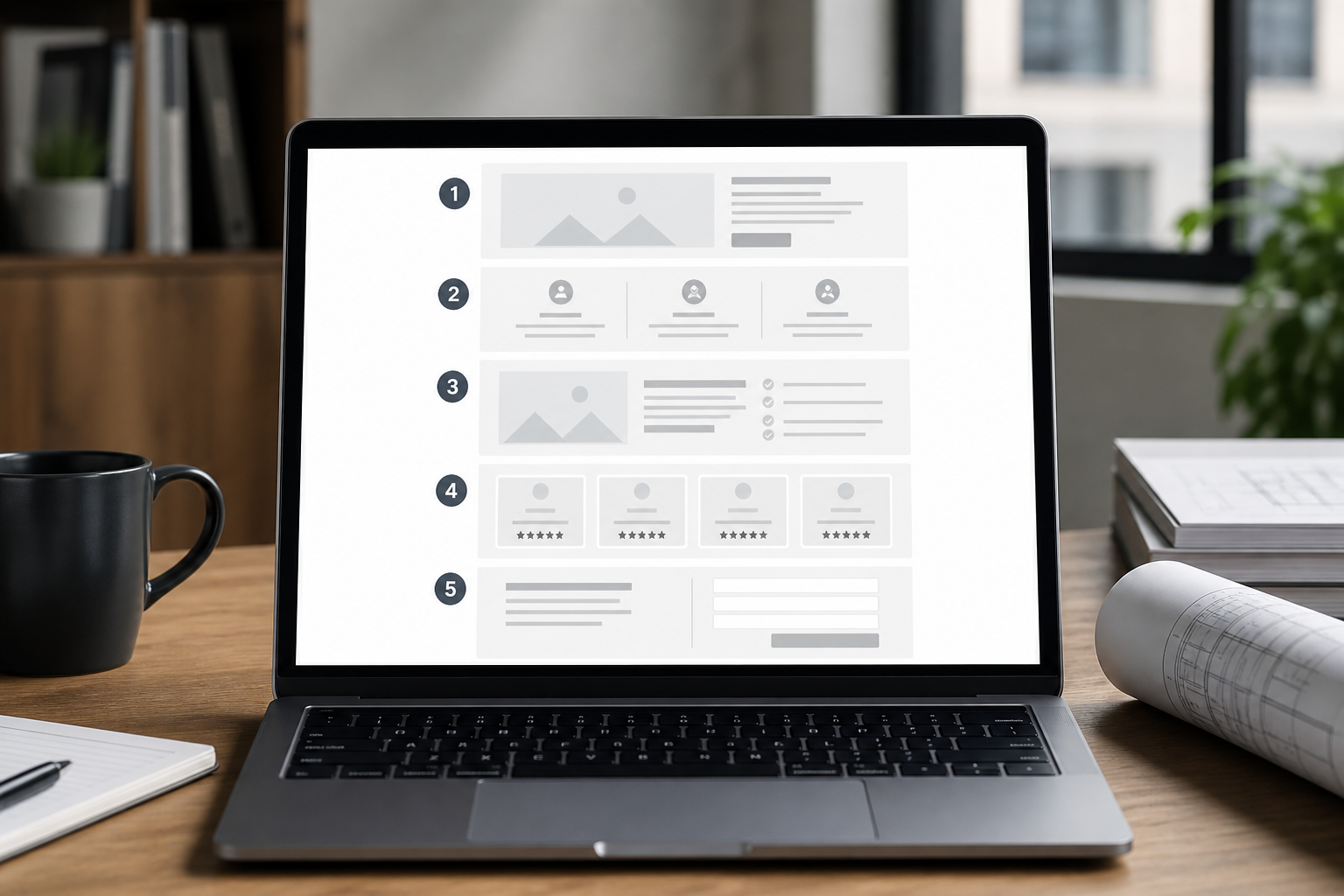
A contractor service page template should provide a useful sequence, not a collection of filler sections. Organize the page around the questions a buyer needs answered before contacting the business.
A practical structure is:
- Service-focused headline: State the service clearly.
- Problem and outcome: Explain what issue the service addresses and what the visitor can discuss or evaluate.
- Primary call to action: Offer a relevant next step near the opening.
- Who the service is for: Describe common project types, property conditions, or signs that may make the service relevant.
- Service area: Name the primary area and accurate nearby coverage.
- Process: Explain what typically happens after an inquiry.
- Project considerations: Note factors that may affect recommendations, scheduling, or scope.
- Proof and qualifications: Include supportable, service-specific trust information.
- Frequently asked questions: Address practical concerns that remain.
- Next step: Repeat or clarify the primary action at the end.
Use descriptive subheadings, short paragraphs, lists, and scannable details. Contractors often receive visitors on phones who are comparing options or trying to solve an immediate problem. Dense blocks of text make it harder to find the answer that determines whether they continue.
The order can change by service. An emergency-related service may need the call to action and response expectations earlier. A complex remodeling service may need more explanation of project fit before requesting detailed information. The framework should adapt to the buyer’s decision, not force every service into identical copy.
Structure check: Map one service page into this sequence: problem, service fit, area, process, proof, questions, and next step. Any missing section may represent an unanswered buyer concern.
How should a service page explain the process without overpromising?
Process information reduces uncertainty when it explains what happens after someone makes contact. It should be specific enough to help the visitor prepare, while leaving room for differences in property condition, project scope, and scheduling.
A contractor may describe a process such as:
- The visitor submits a question, calls, or requests an assessment.
- The contractor reviews the basic project information and determines what details are needed.
- An assessment or conversation helps clarify the condition, goals, and likely scope.
- The contractor explains possible recommendations or next decisions.
- Scheduling and completion depend on the project requirements and agreed arrangements.
The exact steps will vary. State which parts are typical and which depend on the property or project. Tell visitors what information may be helpful, such as the service needed, property location, photos, known damage, access considerations, or preferred contact method, if the business actually uses those details.
Avoid fixed promises about timelines, outcomes, availability, or pricing unless the business can consistently support them. A process section should set expectations, not create an obligation the contractor cannot meet.
A clear call to action should connect to this process. If the next step is to request an assessment, say what the visitor should provide and what the initial response is intended to cover. For additional guidance on making service inquiries easier to understand, read how clear calls to action can support service inquiries.
Process check: Does the page tell a homeowner what to submit, who responds, what the first conversation covers, and what decision follows?
What proof can a contractor use without relying on generic claims?
Proof should relate directly to the service being researched. Broad statements such as “quality work” or “best service” do not give a visitor enough information to compare options or understand what the working relationship may involve.
Use supportable details such as:
- Clearly described examples of the type of work performed.
- Service-specific explanations of what the contractor evaluates.
- Relevant qualifications that can be accurately documented.
- A clear description of communication, recommendations, or project documentation.
- Answers to common questions that demonstrate practical understanding of the service.
Proof does not have to be a collection of promotional statements. Explaining how the contractor approaches an assessment, communicates project considerations, or distinguishes possible solutions can help a visitor evaluate the business more realistically.
Keep every trust statement accurate and connected to the page. If a page says the contractor handles complex projects, explain what that means in terms of project type, assessment, coordination, or scope. If it mentions experience, ensure the statement is supportable and relevant to the service.
Remove claims that do not help a buyer decide. Vague language takes up space that could explain the service, the process, or the next step more clearly.
Proof check: For every trust statement, ask what it means for this specific service and whether the page visibly explains or supports it.
How do you make the next step clear without creating pressure?
The primary call to action should match the visitor’s likely readiness. Someone researching a complicated project may want to ask a question or discuss options. Someone with a clearly identified problem may be ready to request an assessment. The page should offer a useful action without pressuring the visitor into a decision they are not prepared to make.
Place the primary call to action in practical locations:
- Near the opening, after the service and problem are introduced.
- After the process, proof, or project considerations have answered important concerns.
- At the end, where a visitor who has read the page can act immediately.
Use specific language. “Request an assessment,” “Discuss your project,” or “Ask about this service” is usually more informative than a generic “Submit.” Explain what happens after the form is submitted or the call is placed, including what information the visitor should provide when that is known.
Keep secondary navigation from competing with the page’s main purpose. Related services and helpful resources can be useful, but they should not obscure the action the visitor is most likely to need.
Call-to-action check: Can a homeowner identify one obvious next step, understand what to provide, and know what response to expect?
How can you review contractor service page SEO before publishing?
A final review should test more than keyword placement. Confirm that the page is understandable, locally relevant, usable on a phone, and designed around a clear next step.
Use this practical review:
- Confirm service intent: Check that the service name and buyer problem are clear in the title, main heading, introduction, and relevant page elements.
- Confirm location intent: Make the primary service area visible and accurate.
- Check buyer questions: Verify that the page answers service fit, area, process, proof, and next-step questions.
- Review repetition: Remove unnecessary keyword repetition and generic filler.
- Test mobile use: Check readability, form fields, tap targets, page spacing, and access to the primary action.
- Test the conversion path: Submit or otherwise test the form or call action according to the site’s normal process.
- Review navigation: Keep useful internal navigation while ensuring it does not distract from the service page’s purpose.
- Audit unanswered questions: Hide the navigation, skim only the headings, and list what a buyer still needs to know.
The primary keyword should appear naturally where it helps clarify the topic, but useful content remains the priority. For broader practical guidance, see how contractors can improve SEO without a large agency.
If the review reveals missing answers, unclear language, weak calls to action, or technical barriers, a focused audit can help organize the fixes. You can request a website audit from Slate Systems to identify service-page content, structure, and conversion improvements worth prioritizing.
Can a homeowner understand the service you offer and request the right next step without returning to your homepage? If not, improve the page around the questions that determine whether the visitor continues: service, area, process, proof, and action.